<?xml version="1.0" encoding="utf-8"?><feed xmlns="http://www.w3.org/2005/Atom" ><generator uri="https://jekyllrb.com/" version="3.10.0">Jekyll</generator><link href="http://colinmccornack.github.io/feed.xml" rel="self" type="application/atom+xml" /><link href="http://colinmccornack.github.io/" rel="alternate" type="text/html" /><updated>2026-03-23T01:50:02+00:00</updated><id>http://colinmccornack.github.io/feed.xml</id><title type="html">colinmccornack.github.io</title><subtitle>MD/PhD experiences from a current student POV</subtitle><author><name>Colin McCornack</name></author><entry><title type="html">PREP programs and the changing postbacc research pipeline</title><link href="http://colinmccornack.github.io/PREP-program-cuts/" rel="alternate" type="text/html" title="PREP programs and the changing postbacc research pipeline" /><published>2026-03-22T00:00:00+00:00</published><updated>2026-03-22T00:00:00+00:00</updated><id>http://colinmccornack.github.io/PREP-program-cuts</id><content type="html" xml:base="http://colinmccornack.github.io/PREP-program-cuts/"><![CDATA[<p>TL;DR(but you should read 😞) <a href="https://docs.google.com/spreadsheets/d/1Gd_M-fJQg7LHXZulluaqGmmdmZQdZPyEJAV2fgYiYB4/edit?usp=sharing">Semi-updated spreadsheet of postbacc programs, will update in Fall of 2026</a></p>

<p><em>Note: I plan to write a comparison between various postbacc options for MD/PhD applicants. I got quite sidetracked when I realized that many of the opportunities that I used to refer students to no longer existed, and wanted to give updated guidance</em></p>

<p>One of the questions I discuss at length with many applicants is one of time, namely whether or not they should take gap years before applying to MD or MD/PhD programs. To understand the necessity of this, it would be nice to anchor analysis in fact, however, it’s hard to say things with complete confidence because the AAMC only gives us certain information. Looking at the <a href="https://www.aamc.org/data-reports/students-residents/data/facts-enrollment-graduates-and-md-phd">2025 Facts</a>, there aren’t meaningful changes in the key metrics they report - MCAT score or GPA, and they notably don’t report research hours of applicants versus matriculants so instead I will have to rely on anecdote. The number of research hours/research experience seems to be a part of the general arms race in MD and MD/PhD applications, and the resumes of applying and matriculating students to the institution I attend seem to increase in impressiveness year over year. When I applied, the expectation of post-undergrad gap years devoted to research was not universal, but it seems to be somewhat of a necessity nowadays. This is reflected in the data, with <a href="https://insight.jci.org/articles/view/156168">the number of applicants who had taken gap years increasing from 53% in 2013 to 75% in 2020</a>. As someone that went “straight through” (with a semester in between due to my Fall graduation), it’s hard for me to be a staunch proponent of gap years - their impact on the “time to R01” is pronounced, and creates additional hurdles for those either wishing to start families of their own or needing to support parents or siblings financially, in addition to the pernicious comparisons of those around you who are able to do those things earlier in their life than you. However, the utility of these programs in both a) providing resources for application and b) allowing students to work on research full time with greater ownership of a project can help them understand whether or not they want to do the extended training path of MD/PhD programs, so in general I suggest them to students that I advise. Nevertheless, as noted in the paper above in figure 10, there is no significant difference in time to completion between those who took fewer than 3 gap years (and I still personally think the strongest predictor is <a href="https://colinmccornack.github.io/time-to-degree/">which lab you join</a>), and the main explicit benefit thus seems to be the number of publications and abstracts at the time of application.</p>

<p>In previous years, it’s been easy to advise students on this topic and connect them with potential programs. However, one of the consequences of the <a href="https://www.nature.com/collections/jcjhabjhgi">upheavals in scientific funding</a> post-2024 election is the funding one of the main pipelines that connects undergrads to graduate school/MSTPs: PREP programs. Most of these programs were cut on the first day of the Trump Administration, due to no longer effectuating administration priorities due to DEI. The goal of these programs is primarily to give undergraduates from schools that have fewer resources for undergraduate research the opportunity to do mentored scientific research and help them apply to graduate school, and frankly I hadn’t considered the possibility of these programs being cut, as the desired outcome of producing scientists seems clear and potentially <a href="https://www.pewresearch.org/science/2026/01/15/do-americans-think-the-country-is-losing-or-gaining-ground-in-science/">less politically contentious</a> than news may lead you to believe. This was a naive assumption on my part. The scope of the loss of these programs became clear when I began to edit a spreadsheet compiled by <a href="https://faculty.mdanderson.org/profiles/richard_behringer.html">Dr. Richard Behringer</a> containing information about these programs for the students that I mentor, as individual links that I used to send seemed to be inactive. Fewer than 1/3rd of the programs remained after the cuts<span data-pullquote="Fewer than 1/3rd of the programs remained after the cuts"></span>, as you can see in the spreadsheet linked at the top of the page. While the NIH IRTA has experienced hiring freezes in 2024 and 2025, the program is still currently active and accepting applications, which is critical for MSTP applicants as the PREP programs are primarily geared towards PhD applicants due to the differences in the timeline of the applications cycles between MD/MSTP and PhD programs. As Dr. Dahle would say, my crystal ball is cloudy, and making predictions on the future of these programs is a fool’s errand. However, based on recent <a href="https://reporter.nih.gov/search/asV74vJSuEmA3ctsrOmn9A/projects?projects=Active&amp;sort_field=fiscal_year&amp;sort_order=desc">R25 applications</a> it appears that at least some of the programs are slowly trying to rebuild through reframing of the work. For the sake of the future scientists in the pipeline, I can only hope that the situation improves and stabilizes.</p>]]></content><author><name>Colin McCornack</name></author><category term="research" /><category term="postbacc" /><category term="resource" /><summary type="html"><![CDATA[TL;DR(but you should read 😞) Semi-updated spreadsheet of postbacc programs, will update in Fall of 2026]]></summary></entry><entry><title type="html">MCAT Resources</title><link href="http://colinmccornack.github.io/MCAT-Resources/" rel="alternate" type="text/html" title="MCAT Resources" /><published>2025-04-20T00:00:00+00:00</published><updated>2025-04-20T00:00:00+00:00</updated><id>http://colinmccornack.github.io/MCAT-Resources</id><content type="html" xml:base="http://colinmccornack.github.io/MCAT-Resources/"><![CDATA[<p>I pulled most of these from Reddit posts and comments, you can find the links to the original posts/comments at the end of the document</p>
<h2 id="aamc-resources">AAMC Resources:</h2>
<ul>
  <li><a href="https://students-residents.aamc.org/prepare-mcat-exam/free-planning-and-study-resources">AAMC free sample test</a></li>
  <li><a href="https://students-residents.aamc.org/prepare-mcat-exam/free-planning-and-study-resources">AAMC free practice test/Full-length (FL) #5</a></li>
  <li><a href="https://store.aamc.org/mcat-prep/full-length-exams.html">AAMC Full-Length Exams ($35/ea)</a></li>
  <li><a href="https://store.aamc.org/aamc-mcat-section-bank-online.html">AAMC Section Bank #1</a> and <a href="https://store.aamc.org/aamc-mcat-official-prep-section-bank-vol-2.html">#2</a> ($45/ea)
    <h2 id="free-resources">Free Resources</h2>
    <h3 id="jack-westin">Jack Westin:</h3>
  </li>
  <li><a href="https://jackwestin.com/resources/mcat-content/aamc-mcat-science-outline">MCAT Science Content Outline</a></li>
  <li><a href="https://jackwestin.com/mcat-cars-practice-exams/">CARS Practice Exam</a></li>
  <li><a href="https://jackwestin.com/?mcat-diagnostic">MCAT Content Diagnostic</a></li>
  <li><a href="https://jackwestin.com/#daily-passages">Question Bank</a>
    <h3 id="other">Other</h3>
  </li>
  <li><a href="https://www.mcatbros.com/_files/ugd/69e71c_6fb066f455db442685a7472e0226b51b.pdf">MCATBros Behavioral Sciences review doc</a></li>
  <li><a href="https://www.dropbox.com/scl/fi/t1rri4wq85msyf5hxrvvx/KA-P-S-The-Lazy-OCD-Version.docx?rlkey=flx5ipnge4198x7hkow6a9ryk&amp;e=1&amp;dl=0">Khan Academy P/S Condensed Review Doc</a></li>
  <li><a href="https://drive.google.com/file/d/12GGTfWWmj9bT-ejs4qAomV6Pat1tbDgj/view">MCAT Review Sheets (old)</a></li>
</ul>

<h3 id="other-third-party">Other Third party:</h3>
<ul>
  <li><a href="https://www.kaptest.com/static/pdf/ktp-mcat-quicksheets.pdf">Kaplan Quicksheets (FREE)</a></li>
  <li><a href="https://www.kaptest.com/mcat/free/mcat-free-practice-test">Kaplan Half Length Exam (FREE)</a></li>
  <li><a href="https://www.kaptest.com/pg/questkey?clid=30005601">Kaplan Full Length Exam (password: cell)</a></li>
  <li><a href="https://blueprintprep.com/mcat/free-resources/free-mcat-practice-bundle">Blueprint Half-length Diagnostic</a></li>
  <li><a href="https://docs.google.com/spreadsheets/d/1S7zAc5IDFEz9064YU3A0ACm48WqyVvwJyGWtyxCX57Q/edit?gid=1571945416#gid=1571945416">AAMC Full-Length Detailed Explanations</a></li>
</ul>

<h2 id="youtube-and-video-content">YouTube and Video Content:</h2>
<ul>
  <li><a href="https://www.khanacademy.org/test-prep/mcat">Khan Academy</a></li>
  <li><a href="https://www.youtube.com/c/AKLECTURES/playlists">AK Lectures</a></li>
  <li><a href="https://www.youtube.com/c/NinjaNerdScience/playlists">NinjaNerd Science</a></li>
</ul>

<h2 id="anki">Anki:</h2>
<ul>
  <li><a href="https://www.youtube.com/playlist?list=PLXL_lTSgbB_Ufocs2r5ysoTkYgeIgmdJj">The AnKing on using Anki for the MCAT</a></li>
  <li><a href="https://drive.google.com/drive/folders/1riXzrofY7h6UInHbBp0iMjY0LaQ_5Oue">Ortho528 Anki Deck</a></li>
  <li><a href="https://drive.google.com/file/d/1neyVXp_prnmVManHHCB6lZOOL6xEykPE/view">MilesDown Anki Deck</a></li>
  <li><a href="https://drive.google.com/file/d/1zcni3moeevG20iEuKHa443VljXck9Er1/view">MrPankow P/S Deck</a></li>
</ul>

<h2 id="paid-resources">Paid Resources</h2>
<ul>
  <li><a href="https://app.ankihub.net/decks/d7bf5573-65ee-4c40-aa9f-d0b20fd653af">AnKing MCAT deck (requires AnkiHub subscription, ~$6/month)</a></li>
  <li><a href="https://www.kaptest.com/mcat/mcat-books">Kaplan Book Series (I would recommend finding used books, they change very little year to year)</a></li>
  <li><a href="https://gradschool.uworld.com/mcat/question-bank/">UWorld QBank</a></li>
</ul>

<h2 id="op-credits-and-other-mcat-guide-posts">OP Credits and other MCAT guide posts:</h2>
<ul>
  <li><a href="https://old.reddit.com/r/Mcat/comments/p12r0f/the_ultimate_mcat_free_resource_compilation_w/">/u/arvindftw - MCAT free resource compilation</a></li>
  <li><a href="https://old.reddit.com/r/Mcat/comments/1avqg14/my_guide_to_498_to_525_while_working_full_time/">/u/Sandstorm52 - My guide to 498 to 525 while working full time</a></li>
  <li><a href="https://drive.google.com/drive/folders/151WemU5sUBxAdwgwr8TaJLnoXqdKmms7">/u/cheeze1617 guide</a></li>
</ul>]]></content><author><name>Colin McCornack</name></author><category term="mcat" /><category term="application" /><summary type="html"><![CDATA[I pulled most of these from Reddit posts and comments, you can find the links to the original posts/comments at the end of the document AAMC Resources: AAMC free sample test AAMC free practice test/Full-length (FL) #5 AAMC Full-Length Exams ($35/ea) AAMC Section Bank #1 and #2 ($45/ea) Free Resources Jack Westin: MCAT Science Content Outline CARS Practice Exam MCAT Content Diagnostic Question Bank Other MCATBros Behavioral Sciences review doc Khan Academy P/S Condensed Review Doc MCAT Review Sheets (old)]]></summary></entry><entry><title type="html">Creating a study plan for the MCAT</title><link href="http://colinmccornack.github.io/MCAT-Study-Plan/" rel="alternate" type="text/html" title="Creating a study plan for the MCAT" /><published>2025-04-20T00:00:00+00:00</published><updated>2025-04-20T00:00:00+00:00</updated><id>http://colinmccornack.github.io/MCAT-Study-Plan</id><content type="html" xml:base="http://colinmccornack.github.io/MCAT-Study-Plan/"><![CDATA[<p>Before the MCAT, I had never gone through the process of studying for a standardized test, and retrospectively there are many things I wish had done differently.</p>
<h2 id="content-review">Content Review</h2>
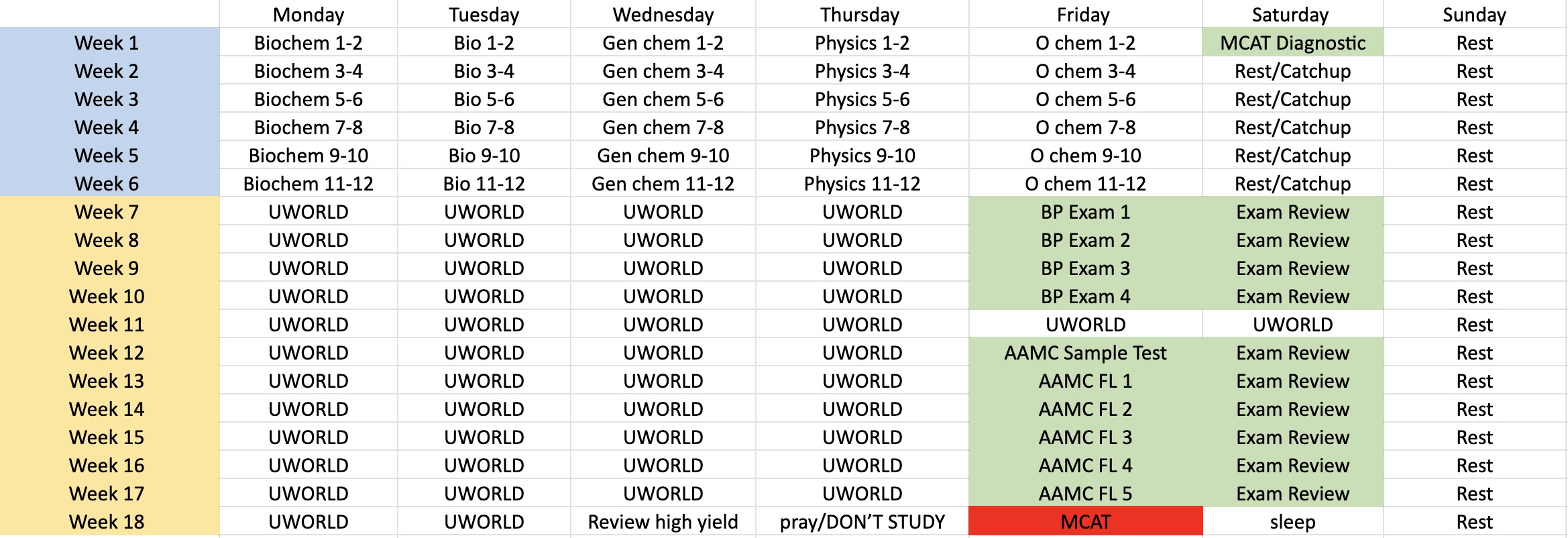
<p>Much of the MCAT is a performance to show that you can memorize and contextualize diverse facts and knowledge areas, which is a valuable and important component of medicine. Traversing the distance between a low score to a median score is largely based on content knowledge. While there are many things that you will need to know that are rote memorization, building a conceptual foundation with concept areas you are less comfortable and confident with is what will lead to initial improvements of a lower score. The initial work of any study plan is going to be focused on content review. While many of the resources available will come at a cost, there are also a variety of free/inexpensive resources that you can use to aid in your studies (<a href="https://colinmccornack.github.io/MCAT-Resources/">link included here</a>). Of purchasable 3rd party review content, Kaplan tends to be the gold standard for C/P and B/B, while most of the P/S content can be captured in the document in the free link, and CARS through Jack Westin. Initial content reviews should be more of a skim than a deep dive, unless you haven’t taken coursework in a specific area. In addition, I would recommend focusing on understanding broader concepts rather than small details that can (and should) be memorized. The essential part of this process is reviewing the content in active ways after covering/learning about it in the books or videos that you are using. I would strongly recommend Anki for this purpose – I don’t think there are other tools that work nearly as well for the long-term retention of information in a systemic manner. If you have never used Anki before, <a href="https://www.youtube.com/watch?v=hrBvE6Wj0Ls">watch this video</a> from The Anking An easy workflow early in the studying process is to read/watch materials in a topic area, and then unsuspend Anki cards in that topic area to review. The amount of time you devote to content review will depend on many factors, namely how recently you took any coursework overlapping with MCAT content, and how much time you can devote to studying per day. In general, I think it’s better to try to shorten the time spent doing a dedicated content review, as time is often better spent reviewing content and doing practice problems and problem sets. If you’re studying “full-time”, you can likely cover the content in about a month, and with partial effort (a much more likely scenario) it can take ~6-8 weeks, again depending on how recently you’ve taken courses on the material and how much time you can spend covering content and reviewing. 
<img src="/images/example_MCAT_study_schedule.jpg" alt="Image" /></p>
<h2 id="practice-practice-practice">Practice, practice, practice</h2>
<p>At the end of the dedicated content review is when the focus will change to primarily doing practice problems and reviewing any weak spots in your knowledge. This will likely take 4-6 weeks if studying full time, and 6-10 weeks if studying part time. UWorld is the preferred tool for practice problems but carries a hefty cost, and Jack Westin seems to be the preferred recourse for CARS specifically. I would recommend a consistent routine of practice question banks every day to get into the practice of answering questions, which is the real purpose of this (and any) exam. This would look like a combination of a few CARS passages from Jack Westin, and then question banks from UWorld, following by review of the mistakes, making any new Anki cards if needed, and then doing daily Anki cards. In general, I have two major recommendations for this period in studying. The first is to do weekly full-length exams (FLs) in a setting like that of the real exam – this is something that you can also do in the content review phase of your studying, and I think doing this with 3rd party exams during this time is particularly useful. For your practice exams, go to a quiet place, eliminate any distractions, and take breaks in the same order and timing as the real exam. The goal of this is to practice the process of exam taking, so that the real exam will be a continuation of the practice that you have been doing, as opposed to something new and foreign. However, unless you’re taking AAMC FLs, this will essentially be a question bank that is completed in one sitting, which although maybe not perfectly representative of the real exam, still has merit for building endurance and routine. There are a lot of opinions regarding which 3rd party full-length exams are worth taking and most representative of the real exam, and though this has certainly changed in the many years since I have taken the exam, people seem to prefer Altius, NextStep, and Kaplan, although the CARS sections for both companies (and most 3rd party FLs) are not representative of AAMC. AAMC FLs should be saved for the end of your studying and completed in the last weeks before the exam. The second (and more important) recommendation is to rigorously review mistakes made in the full-length practice exams – after taking a break post-practice exam, the rest of your study time for that day should be spent reviewing the exam as the content and your rationale is still fresh in your mind. Of course, if you find your focus waning during this time, just split up the review, as it really shouldn’t be something done by “going through the motions”. This was challenging for me to do during the MCAT, and it wasn’t until Step 1 that I felt like I was able to be honest and not dismissive of my mistakes. A good way to do this is to make a spreadsheet of the mistakes, and then make Anki cards of the subject/content if the mistake was in conceptual/content knowledge. In the spreadsheet, you should include the content category, subtopic, rationale and mistake in your reasoning, and then the correct reasoning. Categorizing and cataloging the mistakes will help you to identify trends or areas of weakness in your study which you can the remedy through focused content study, and I reviewed I reviewed my version of this document all the way through the week before my actual exam.</p>
<h2 id="parting-words">Parting words</h2>
<p>My last recommendation is to ignore FOMO. Make a plan and stick with it. You can be flexible in adding or removing things that are not working in the studying but try and set hard limits/be firm with how much advice and change you’re willing to read/make during your study process. For both the MCAT and Step 1, I remember seeing posts on SDN/Reddit of people who got exceptional scores on the exam with their breakdown of what to do (I do see the irony in this given the purpose of this post and website…), and I would try and adapt and change what I was doing out of the fear of missing a crucial technique or way to potentially improve my score. Don’t get lost in the sauce. Before you start studying, find/purchase all the resources you intend to use. Set aside time to make a personalized plan of how to approach studying, integrating the advice from myself or others on Reddit or SDN, and then follow your plan. Make sure to include breaks and flex time within your schedule, as things will inevitably come up and disrupt your plans, and devoting focused time to studying is much better than burning out because you didn’t want to take a day off (except for Anki, keep reviewing that on your “off-days”).</p>]]></content><author><name>Colin McCornack</name></author><category term="mcat" /><category term="application" /><summary type="html"><![CDATA[Before the MCAT, I had never gone through the process of studying for a standardized test, and retrospectively there are many things I wish had done differently. Content Review Much of the MCAT is a performance to show that you can memorize and contextualize diverse facts and knowledge areas, which is a valuable and important component of medicine. Traversing the distance between a low score to a median score is largely based on content knowledge. While there are many things that you will need to know that are rote memorization, building a conceptual foundation with concept areas you are less comfortable and confident with is what will lead to initial improvements of a lower score. The initial work of any study plan is going to be focused on content review. While many of the resources available will come at a cost, there are also a variety of free/inexpensive resources that you can use to aid in your studies (link included here). Of purchasable 3rd party review content, Kaplan tends to be the gold standard for C/P and B/B, while most of the P/S content can be captured in the document in the free link, and CARS through Jack Westin. Initial content reviews should be more of a skim than a deep dive, unless you haven’t taken coursework in a specific area. In addition, I would recommend focusing on understanding broader concepts rather than small details that can (and should) be memorized. The essential part of this process is reviewing the content in active ways after covering/learning about it in the books or videos that you are using. I would strongly recommend Anki for this purpose – I don’t think there are other tools that work nearly as well for the long-term retention of information in a systemic manner. If you have never used Anki before, watch this video from The Anking An easy workflow early in the studying process is to read/watch materials in a topic area, and then unsuspend Anki cards in that topic area to review. The amount of time you devote to content review will depend on many factors, namely how recently you took any coursework overlapping with MCAT content, and how much time you can devote to studying per day. In general, I think it’s better to try to shorten the time spent doing a dedicated content review, as time is often better spent reviewing content and doing practice problems and problem sets. If you’re studying “full-time”, you can likely cover the content in about a month, and with partial effort (a much more likely scenario) it can take ~6-8 weeks, again depending on how recently you’ve taken courses on the material and how much time you can spend covering content and reviewing. Practice, practice, practice At the end of the dedicated content review is when the focus will change to primarily doing practice problems and reviewing any weak spots in your knowledge. This will likely take 4-6 weeks if studying full time, and 6-10 weeks if studying part time. UWorld is the preferred tool for practice problems but carries a hefty cost, and Jack Westin seems to be the preferred recourse for CARS specifically. I would recommend a consistent routine of practice question banks every day to get into the practice of answering questions, which is the real purpose of this (and any) exam. This would look like a combination of a few CARS passages from Jack Westin, and then question banks from UWorld, following by review of the mistakes, making any new Anki cards if needed, and then doing daily Anki cards. In general, I have two major recommendations for this period in studying. The first is to do weekly full-length exams (FLs) in a setting like that of the real exam – this is something that you can also do in the content review phase of your studying, and I think doing this with 3rd party exams during this time is particularly useful. For your practice exams, go to a quiet place, eliminate any distractions, and take breaks in the same order and timing as the real exam. The goal of this is to practice the process of exam taking, so that the real exam will be a continuation of the practice that you have been doing, as opposed to something new and foreign. However, unless you’re taking AAMC FLs, this will essentially be a question bank that is completed in one sitting, which although maybe not perfectly representative of the real exam, still has merit for building endurance and routine. There are a lot of opinions regarding which 3rd party full-length exams are worth taking and most representative of the real exam, and though this has certainly changed in the many years since I have taken the exam, people seem to prefer Altius, NextStep, and Kaplan, although the CARS sections for both companies (and most 3rd party FLs) are not representative of AAMC. AAMC FLs should be saved for the end of your studying and completed in the last weeks before the exam. The second (and more important) recommendation is to rigorously review mistakes made in the full-length practice exams – after taking a break post-practice exam, the rest of your study time for that day should be spent reviewing the exam as the content and your rationale is still fresh in your mind. Of course, if you find your focus waning during this time, just split up the review, as it really shouldn’t be something done by “going through the motions”. This was challenging for me to do during the MCAT, and it wasn’t until Step 1 that I felt like I was able to be honest and not dismissive of my mistakes. A good way to do this is to make a spreadsheet of the mistakes, and then make Anki cards of the subject/content if the mistake was in conceptual/content knowledge. In the spreadsheet, you should include the content category, subtopic, rationale and mistake in your reasoning, and then the correct reasoning. Categorizing and cataloging the mistakes will help you to identify trends or areas of weakness in your study which you can the remedy through focused content study, and I reviewed I reviewed my version of this document all the way through the week before my actual exam. Parting words My last recommendation is to ignore FOMO. Make a plan and stick with it. You can be flexible in adding or removing things that are not working in the studying but try and set hard limits/be firm with how much advice and change you’re willing to read/make during your study process. For both the MCAT and Step 1, I remember seeing posts on SDN/Reddit of people who got exceptional scores on the exam with their breakdown of what to do (I do see the irony in this given the purpose of this post and website…), and I would try and adapt and change what I was doing out of the fear of missing a crucial technique or way to potentially improve my score. Don’t get lost in the sauce. Before you start studying, find/purchase all the resources you intend to use. Set aside time to make a personalized plan of how to approach studying, integrating the advice from myself or others on Reddit or SDN, and then follow your plan. Make sure to include breaks and flex time within your schedule, as things will inevitably come up and disrupt your plans, and devoting focused time to studying is much better than burning out because you didn’t want to take a day off (except for Anki, keep reviewing that on your “off-days”).]]></summary></entry><entry><title type="html">Communicating your research</title><link href="http://colinmccornack.github.io/research-talks/" rel="alternate" type="text/html" title="Communicating your research" /><published>2025-02-09T00:00:00+00:00</published><updated>2025-02-09T00:00:00+00:00</updated><id>http://colinmccornack.github.io/research-talks</id><content type="html" xml:base="http://colinmccornack.github.io/research-talks/"><![CDATA[<p>One of the most essential parts of science is communication. Begin able to eloquently communicate your research, your motivations for pursuing research, and to do so with confidently and comfortably with different audiences is a skill itself and deserves practice. Personally, I think there are three different “versions” of a prepared research talk that are useful to practice: the elevator pitch, a longer research description, and a research motivations and goals talk. Before we talk about those, we need to first talk about the crucial part of any conversation about science – knowing your audience.</p>
<h3 id="know-you-audience">Know you audience</h3>
<p>Knowing your audience is a crucial part of any form of communication, and science communication is no different. The specific foci and things you choose to highlight will differ if you’re talking to a policymaker versus a family member versus a tenured PI. For most “elevator pitches”, your audience will be either faculty/colleagues, or lay public. For other versions of the prepared research talk, most of your audience members will be those involved in science, either in your field or adjacent areas. Regardless, there are a few universal considerations that you should consider regardless of the audience.</p>
<h5 id="number-talk">Number talk</h5>
<p>When you’re introducing numbers or statistics (which is very useful for supporting your findings or motivations of your work), there are a few tricks you can use with your phrasing to improve your communication and impact. First, avoid using probabilities and stick to natural frequencies (i.e. instead of saying “the probability of getting X disease is 1%”, say “1 in 100 people get X disease). Second, avoid anchoring results in statistical significance, as this can be challenging conceptually depending on your audience. Instead of saying your p-value, talk about the magnitude of the effect size, again using a natural frequency if possible.</p>
<h5 id="avoid-jargon">Avoid jargon</h5>
<p>While field specific terms and jargon are useful shorthand for communicating quickly with our colleagues, they can be unknown and misunderstood when talking with people outside of our discipline. When you’re constructing your talk, try to replace more scientific terms with ones of the same meaning (e.g. “low oxygen” instead of “hypoxic”, “DNA damaging” instead of “mutagenic”) to improve clarity and understanding.</p>
<h3 id="the-elevator-pitch">The elevator pitch</h3>
<p>Even though it’s called an elevator pitch, this will be the most useful talk to prepare, and will come in handy at conferences, meetings, or simply describing the gist of your research to your peers or colleagues. As stated above, you first need to frame your work around the question of What is the “big problem”: Contextualize the issue that you are studying. It is best to start quite broad. If your research is related to disease or illness, start by describing the frequency, overall survival, or other important statistics about the disease itself. If your research is focused on basic science, focus instead on the limitation in knowledge you are trying to solve, or other motivations for pursuing the research. For the introductory sentence, it’s important to frame the core problem of your research with as wide of a lens as possible. “X disease is bad and impacts Y amount of people”. “X is a large issue in biology and furthering our understanding will help us to do Y”.</p>

<p>After we’ve introduced the “big problem”, you can start your descent from large to small(er). As you’re transitioning from the “big problem” to your specific research topic, you want to start to reduce the scope and scale of the problem to one that you can realistically solve, all while anchoring the specific work that you do into the larger issue you introduced. Some ways to do this are to a transitional word or phrase, such as “in particular, X is a bad problem because …”, or to talk about the specific result of the big issue, such as “X is bad because it can cause <em>your specific outcome/research focus</em>”. This can come at the tail end of the introduction of the “big problem”, or in a following sentence.</p>

<p>Now that you’ve narrowed the focus to the specific work that you are doing, it’s time to talk about it! Get more specific about how the work you’re doing right now is working to solve a defined problem that is connected to the “big problem”. After defining and describing the current work, it’s time to move into larger, grander goals. If your current work succeeds, what are you hoping to do next? How will a positive or negative result of your work impact our understanding of the “big problem” at large? Just as you went from large -&gt; small when transitioning from the “big problem” to your specific research, in the tail end of the elevator pitch it’s time to go from small -&gt; large, as you talk about the potential impact of the work (while also trying to not overstate it).</p>
<h4 id="variations-on-a-theme-of-elevator-pitch">Variations on a theme of elevator pitch</h4>
<p>Although we know that context and audience is key, changes in your audience can also change the structure and time that you spend in individual areas of your elevator pitch. If you’re talking to someone in your specific field or subdiscipline, you can skip over a lot of the more general background, as you have a common point of familiarity with your listener, and it would be redundant. In turn, this will give you the opportunity to expand on specific topics or go into greater depth with your experimental design, current results, or future directions. The need to avoid specific words or jargon is also lessened since you have a shared language within your subfield, although specific terms or abbreviations should still be introduced to ensure common understanding.</p>
<h5 id="the-longer-research-description">The “longer research description”</h5>
<p>In addition to a version of your elevator pitch with an abbreviated background when talking with someone who has a common background or area of focus, there is a version which I think of as the “longer research description”. As the name implies, this is a longer talk, usually 5-10 minutes, and useful when describing your interest to someone in an interview context, or during a longer conversation at a conference. If the shape of an elevator pitch is an hourglass (big idea -&gt; small, solvable problem -&gt; big future directions), the “longer research description” is essentially just an elongated hourglass. During this, you can both expand the background portion of your elevator pitch, and weave in work that your lab/research group has previously done to further contextualize your current work and show how your current work is the natural “next step” of the previous work. This has a dual function of building legitimacy with your audience of both your current pursuit (as it’s the logical next step) as well as the work of your research group/lab. The actual description of the work itself can be more in depth as well, focusing on nuances or issues that may be obscured or not focused on in a shorter elevator pitch. In an interview context, this can help to show your ingenuity and ability to solve problems as they appear in research, which is a fundamental skill that is needed to be a good researcher. The future directions of the work can be similarly lengthened and can also provide an opportunity to discuss some of these future ideas with a colleague or potential collaborator.</p>
<h3 id="the-research-motivations-and-goals-talk">The research motivations and goals talk</h3>
<p>While we’ve spent the time thus far talking about the structure of an elevator pitch, which is designed to communicate and contextualize your research in a digestible and approachable manner, the research motivations and goals talk is less structured and designed to communicate your personal goals and ambitions with research (and medicine). This is a talk to answer the question of “What do you see yourself doing in a career as an MD/PhD?” Because this is a personal question, there isn’t a correct/incorrect answer to this question, but there still are essential components that you should communicate when discussing this topic. Key to this is <strong>why you need an MD/PhD to do what you want to do</strong>. Oh you want to do research? Why not just get a PhD then? You want to practice medicine and do clinical trials? What’s the need to get a PhD then? To me, the key component of getting a PhD is the process of investigation and learning how to think and approach problems like a scientist. This is a unique skillset that takes time and mentorship to develop well, and doing so will allow you to gain true expertise in a field and guide investigations into scientific and clinical problems. In your answer, you need to balance out the desires to get both degrees, emphasizing the need of clinical practice alongside scientific investigation. How will you integrate both research and medicine into your career? What balance between clinical and research responsibilities do you hope to have? What specific experiences motivated you to pursue an MD/PhD? Having answers to these questions will both help you structure an answer to these questions for interviews or applications, but also provide a genuine chance to reflect on your personal motivations for pursuing this degree pathway.</p>]]></content><author><name>Colin McCornack</name></author><category term="elevator-pitch" /><category term="research" /><category term="talk" /><category term="communication" /><summary type="html"><![CDATA[One of the most essential parts of science is communication. Begin able to eloquently communicate your research, your motivations for pursuing research, and to do so with confidently and comfortably with different audiences is a skill itself and deserves practice. Personally, I think there are three different “versions” of a prepared research talk that are useful to practice: the elevator pitch, a longer research description, and a research motivations and goals talk. Before we talk about those, we need to first talk about the crucial part of any conversation about science – knowing your audience. Know you audience Knowing your audience is a crucial part of any form of communication, and science communication is no different. The specific foci and things you choose to highlight will differ if you’re talking to a policymaker versus a family member versus a tenured PI. For most “elevator pitches”, your audience will be either faculty/colleagues, or lay public. For other versions of the prepared research talk, most of your audience members will be those involved in science, either in your field or adjacent areas. Regardless, there are a few universal considerations that you should consider regardless of the audience. Number talk When you’re introducing numbers or statistics (which is very useful for supporting your findings or motivations of your work), there are a few tricks you can use with your phrasing to improve your communication and impact. First, avoid using probabilities and stick to natural frequencies (i.e. instead of saying “the probability of getting X disease is 1%”, say “1 in 100 people get X disease). Second, avoid anchoring results in statistical significance, as this can be challenging conceptually depending on your audience. Instead of saying your p-value, talk about the magnitude of the effect size, again using a natural frequency if possible. Avoid jargon While field specific terms and jargon are useful shorthand for communicating quickly with our colleagues, they can be unknown and misunderstood when talking with people outside of our discipline. When you’re constructing your talk, try to replace more scientific terms with ones of the same meaning (e.g. “low oxygen” instead of “hypoxic”, “DNA damaging” instead of “mutagenic”) to improve clarity and understanding. The elevator pitch Even though it’s called an elevator pitch, this will be the most useful talk to prepare, and will come in handy at conferences, meetings, or simply describing the gist of your research to your peers or colleagues. As stated above, you first need to frame your work around the question of What is the “big problem”: Contextualize the issue that you are studying. It is best to start quite broad. If your research is related to disease or illness, start by describing the frequency, overall survival, or other important statistics about the disease itself. If your research is focused on basic science, focus instead on the limitation in knowledge you are trying to solve, or other motivations for pursuing the research. For the introductory sentence, it’s important to frame the core problem of your research with as wide of a lens as possible. “X disease is bad and impacts Y amount of people”. “X is a large issue in biology and furthering our understanding will help us to do Y”.]]></summary></entry><entry><title type="html">A look at the data - National MD-PhD Program Outcomes Study</title><link href="http://colinmccornack.github.io/National-MD-PhD-outcomes-study/" rel="alternate" type="text/html" title="A look at the data - National MD-PhD Program Outcomes Study" /><published>2025-01-29T00:00:00+00:00</published><updated>2025-01-29T00:00:00+00:00</updated><id>http://colinmccornack.github.io/National-MD-PhD-outcomes-study</id><content type="html" xml:base="http://colinmccornack.github.io/National-MD-PhD-outcomes-study/"><![CDATA[<p>To get a good idea of what can be done with an MD/PhD, our best reference frame is those who have completed their training. The AAMC puts out yearly reports of data gathered from residency applications and makes it available as a comprehensive report (Charting Outcomes) and gathers similar data from medical school applications (FACTS). Less frequently, they do assessments of the workforce and former trainees, and in 2018 the AAMC conducted a study to look at the outcomes of physician-scientists produced by the MSTP &amp; MD/PhD programs from around the country <a href="https://store.aamc.org/downloadable/download/sample/sample_id/162/">which can be found here</a>. While some of the data will have certainly changed in the past 7 years since this study was conducted, it is still useful to understand the common outcomes and careers of the people who have completed this training. The survey was (unsurprisingly) voluntary and had a completion rate of 44%, and although they note that the response rate was similar between sexes, it is impossible to know if there is bias with respect to the outcomes of those who completed the survey, e.g. academic physicians preferentially responding.</p>

<h3 id="approaching-sex-parity">Approaching sex parity</h3>
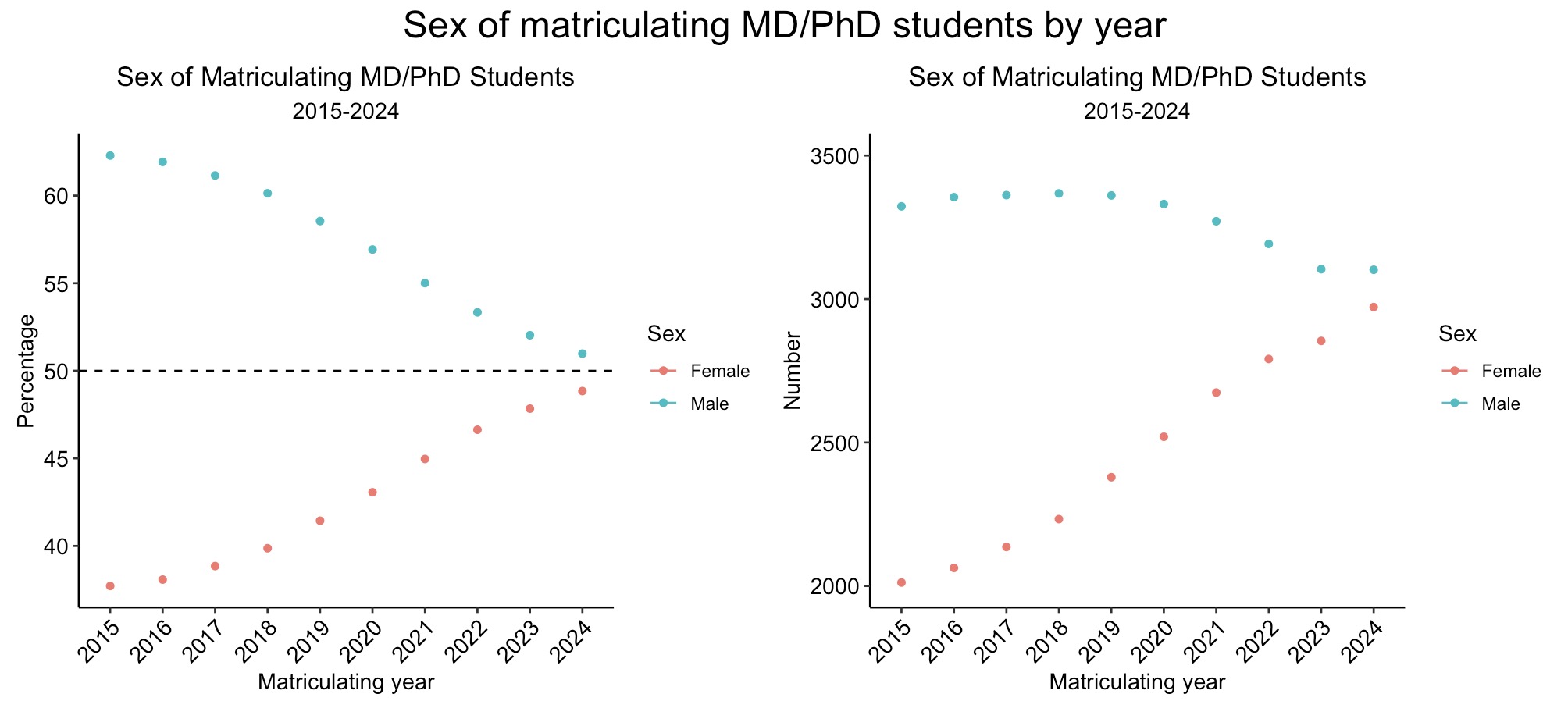
<p>In Figure 4, we can see the gradual progress towards sex parity in MD/PhD graduates since 1974. Starting with almost 100% of graduates identified as male from AAMC application data, we can see the lines representing the percent of men and women slowly converging as time passes. In the key takeaways of the report, the AAMC notes that this process was slower with MD/PhD graduates than MD-only graduates. We can see the continuation of this trend in matriculating students in the subsequent years not included in the study, with gender parity almost achieved in the matriculants in 2024. Up until around 2020, this progression towards parity did not come at the cost of fewer males matriculating, but an increase in the overall matriculants to MD/PhD programs. However, beginning in 2020 the amount of male matriculants begins to decrease, which mirrors broader demographic shifts of fewer men enrolling in higher education. Given the similar shifts in demographic trends amongst both medical student matriculants and graduate student matriculants, and a continued decrease of male enrollment in higher education, it will not be surprising to see women become the majority of MD/PhD matriculants in the years ahead. 
<img src="/images/mdphd_outcomes_sex_by_year.jpg" alt="Image" /></p>

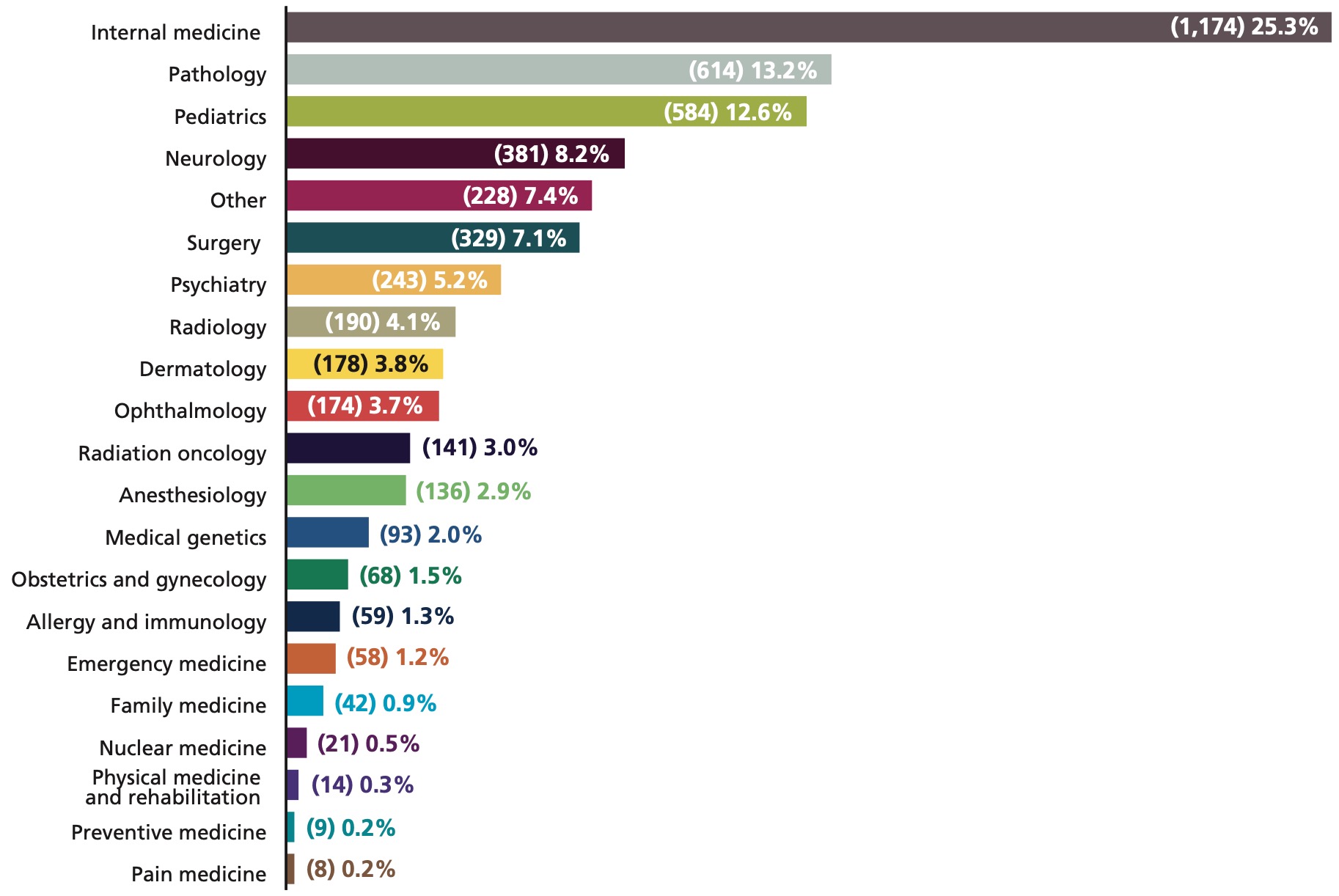
<h3 id="most-respondents-who-start-work-in-academia-stay-in-academia-and-complete-residencies-in-im-pathology-or-pediatrics">Most respondents who start work in academia stay in academia, and complete residencies in IM, pathology or pediatrics</h3>
<p>For the respondents who went on to complete residency training and start working in academia, they tend to stay in academia, with ~85% of respondents following this pathway. However, this first workplace choice varied widely by medical specialty, and those who did not complete subspecialty/fellowship training were less likely to work in academia as their first job. The time to the first position in academia for IM subspecialties generally reflect the length of the respective subspecialty training duration. Historically, MD/PhD graduates have typically done postgraduate residency training in IM, pathology, pediatrics, and neurology. However, this is beginning to change, with equal percentages of graduates in surgery and neurology, and 1/3rd of all graduates completing training in specialties other than IM, pathology, pediatrics, neurology, and surgery. 
<img src="/images/mdphd_residency_choice.jpg" alt="Image" /></p>

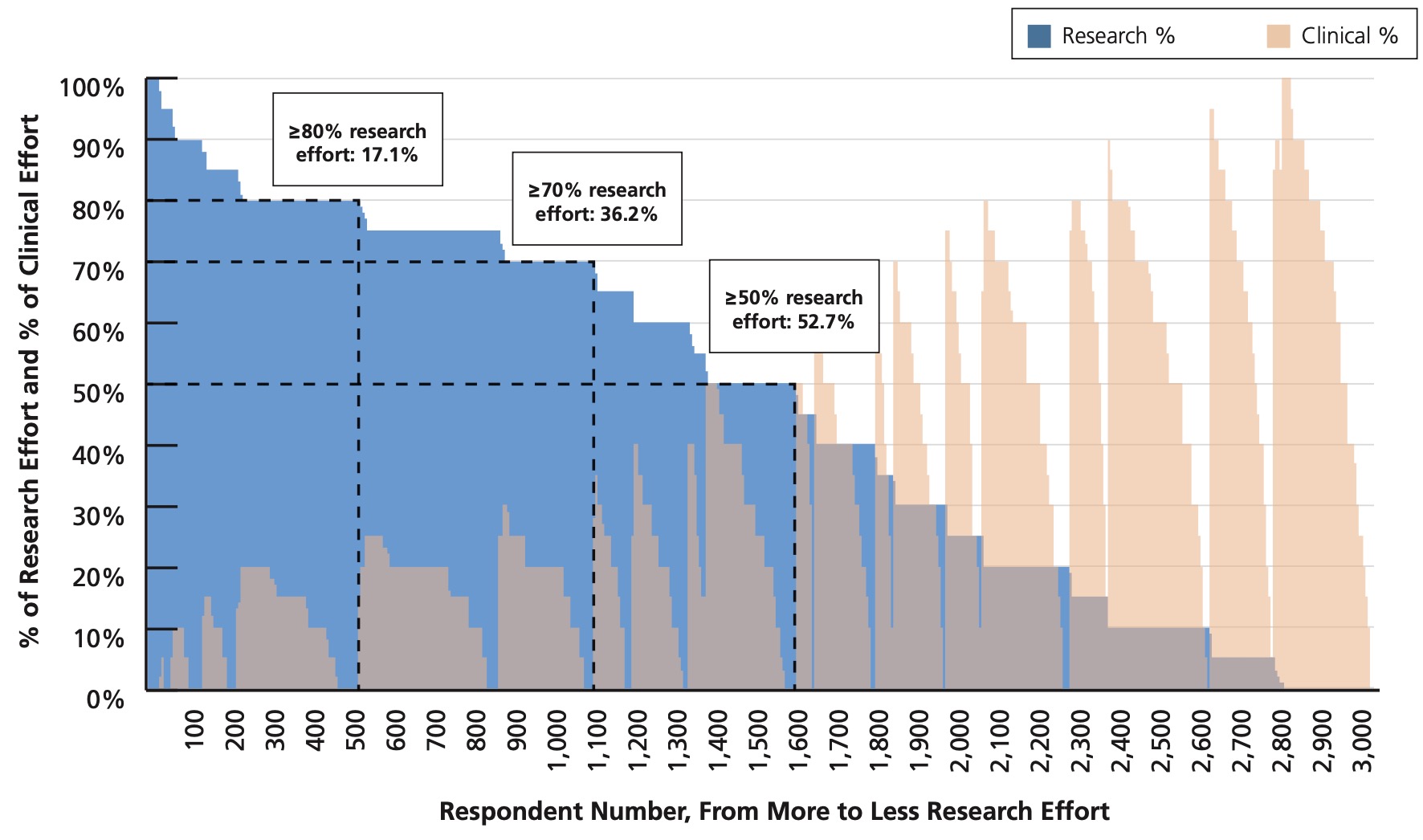
<h3 id="few-respondents-have-an-80-research-20-clinical-split-but-a-slim-majority-have-50-research-effort">Few respondents have an 80% research, 20% clinical split, but a slim majority have 50% research effort</h3>
<p>Of the respondents, only 17.1% have the “classical” 80% research, 20% clinical split. However, that isn’t to say that many graduates do not have a large portion of their time devoted to research, as 36.2% have a 70% research, 30% clinical split, and roughly 50% of the respondents have an equal divide between their research and clinical effort. Unsurprisingly, these percent efforts vary based on current grant funding, with those who are PIs on non-NIH grants and NIH career development awards/NIH research grants devoting ~2/3rds and ~3/4ths of their time to research, respectively. Interestingly, 51% of all respondents who are PIs on research grants only receive funding from non-NIH grants, with many having funding from multiple different sources (such as private foundations, pharma/biotech, or other federal and private sources). 
<img src="/images/mdphd_research_split.jpg" alt="Image" /></p>

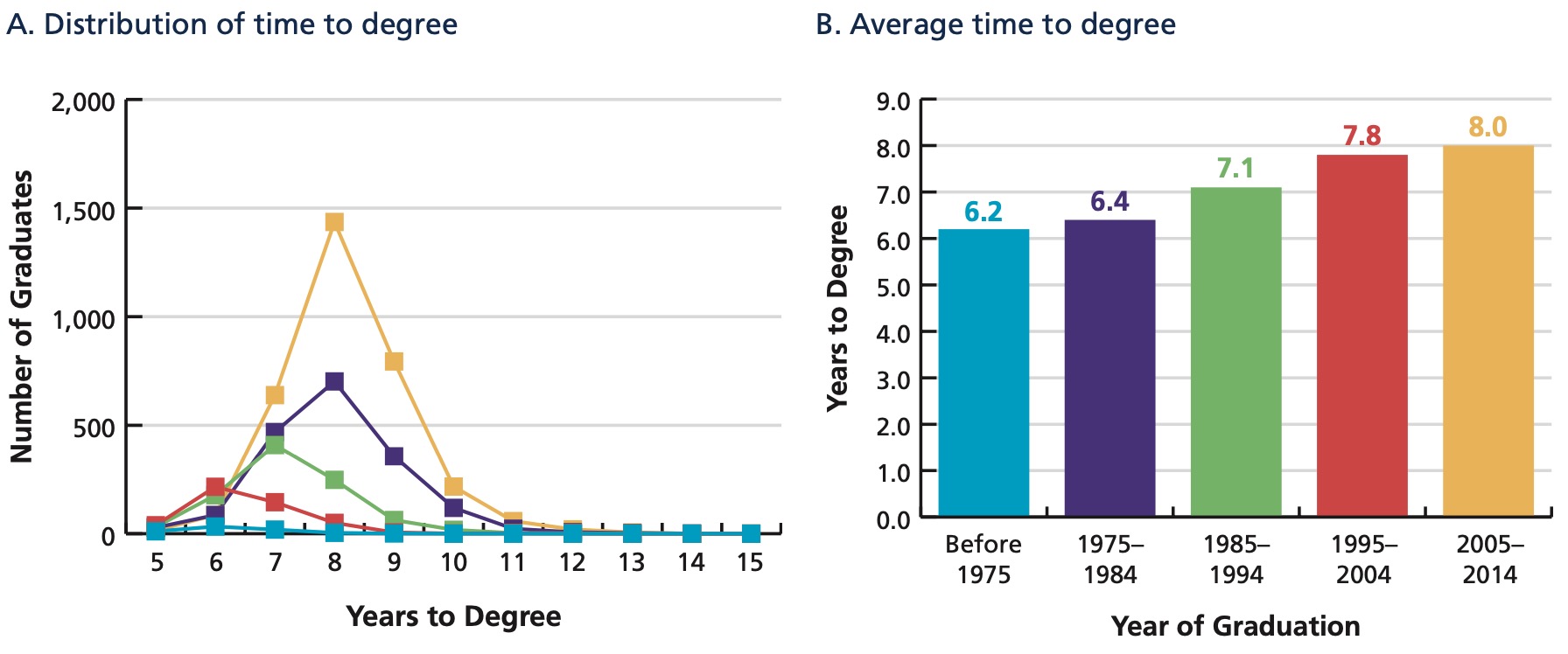
<h3 id="the-duration-of-degrees-and-time-to-first-faculty-positions-continues-to-increase">The duration of degrees and time to first faculty positions continues to increase</h3>
<p>This is a topic that warrants a post of its own (which will come in due time), but the average time to degree, as well as the shape of the distribution, has shifted greatly since the earlier days of combined MD/PhD programs to the present. The average time to degree has increased from 7 years or less before 1994 to 8 years from 2005-2014. When I was applying for programs, based on the program information on websites it seems like this value is continuing to creep up, and I would not be surprised to see an increase in the value in years to come. Secondarily, the time to faculty positions (be it instructor positions or assistant professors) has also seen a striking increase since the earliest days, although the median and overall distribution is essentially the same from 1985-1994 as 1995-2004. However, this information is not very recent, and it will be interesting to see how this value changes in the years to come (likely increasing given the decreasing amount of available faculty positions as well as available research funding). 
<img src="/images/mdphd_time_to_degree.jpg" alt="Image" /></p>]]></content><author><name>Colin McCornack</name></author><category term="outcomes" /><category term="research-split" /><category term="graduate" /><summary type="html"><![CDATA[To get a good idea of what can be done with an MD/PhD, our best reference frame is those who have completed their training. The AAMC puts out yearly reports of data gathered from residency applications and makes it available as a comprehensive report (Charting Outcomes) and gathers similar data from medical school applications (FACTS). Less frequently, they do assessments of the workforce and former trainees, and in 2018 the AAMC conducted a study to look at the outcomes of physician-scientists produced by the MSTP &amp; MD/PhD programs from around the country which can be found here. While some of the data will have certainly changed in the past 7 years since this study was conducted, it is still useful to understand the common outcomes and careers of the people who have completed this training. The survey was (unsurprisingly) voluntary and had a completion rate of 44%, and although they note that the response rate was similar between sexes, it is impossible to know if there is bias with respect to the outcomes of those who completed the survey, e.g. academic physicians preferentially responding.]]></summary></entry><entry><title type="html">What determines time to degree?</title><link href="http://colinmccornack.github.io/time-to-degree/" rel="alternate" type="text/html" title="What determines time to degree?" /><published>2025-01-12T00:00:00+00:00</published><updated>2025-01-12T00:00:00+00:00</updated><id>http://colinmccornack.github.io/time-to-degree</id><content type="html" xml:base="http://colinmccornack.github.io/time-to-degree/"><![CDATA[<p>MD-PhD programs are long. In recent years, there have been pushes in medical schools and MSTP/MD-PhD programs to reduce the overall length of training. When looking longitudinally, we can see how the timeline to having a career (and lab) of one’s own can be quite extended: 6-10 years for MD/PhD, 3-6 years for residency/fellowship, and a few years of postdoctoral research, and maybe post-baccalaureate research prior to all of this. The biggest factor that will determine the time to completion of dual degrees is your PhD lab.<span data-pullquote="The biggest factor that will determine the time to completion of dual degrees is your PhD lab."></span> Because medical school curricula are more-or-less fixed in their schedules, the differences in time to completion of MD-PhDs comes from the PhD phase of time. Your PhD lab will determine the topic area and scope of your individual projects, your level of independence or collaboration with others in your lab/externally, and a reference frame for what amount of work in sum can constitute a PhD. The average time to completion of biomedical PhDs in the United States floats around 5-6 years, and MSTPs are able to help reduce this usually by double-counting MD coursework towards the coursework requirements of PhD programs. However, the time constraints and logistics of re-entering the medical school curriculum can pose unique challenges to MD/PhD students in their PhD phase, leading many to pursue projects with defined goals and endpoints, and incentivize projects that use existing resources in the lab. That isn’t to say that it is impossible to go off on your own, as many students are able to leverage this opportunity to do so and find success through it. Because of these constraints, it’s important to have frank conversations with your PI or potential PIs about your timeline. If finishing your PhD work within a 4 year timeframe is essential, you need to communicate that to the PIs you meet with/rotate with. Moreover, this is another instance where talking to students currently in a lab can be very useful, as it can provide you a better glimpse of implicit expectations of a PI with respect to time to completion: If the majority of PhD students in a lab are finishing in ~6 years, it may be challenging to get something off the ground and sufficient to finish your PhD in the restricted timeframe. All that being said, the PhD is a time to sponge up diverse skillsets which you can use in your academic career ahead. You are unlikely to have as much protected time as the PhD affords you to explore topic areas and fail with lower stakes. While time is undoubtedly important and the cause of much stress, taking the time that you need to hone your craft and grow as a scientist is essential, and shouldn’t be rushed.</p>]]></content><author><name>Colin McCornack</name></author><category term="programs" /><category term="PhD" /><category term="timeline" /><summary type="html"><![CDATA[MD-PhD programs are long. In recent years, there have been pushes in medical schools and MSTP/MD-PhD programs to reduce the overall length of training. When looking longitudinally, we can see how the timeline to having a career (and lab) of one’s own can be quite extended: 6-10 years for MD/PhD, 3-6 years for residency/fellowship, and a few years of postdoctoral research, and maybe post-baccalaureate research prior to all of this. The biggest factor that will determine the time to completion of dual degrees is your PhD lab. Because medical school curricula are more-or-less fixed in their schedules, the differences in time to completion of MD-PhDs comes from the PhD phase of time. Your PhD lab will determine the topic area and scope of your individual projects, your level of independence or collaboration with others in your lab/externally, and a reference frame for what amount of work in sum can constitute a PhD. The average time to completion of biomedical PhDs in the United States floats around 5-6 years, and MSTPs are able to help reduce this usually by double-counting MD coursework towards the coursework requirements of PhD programs. However, the time constraints and logistics of re-entering the medical school curriculum can pose unique challenges to MD/PhD students in their PhD phase, leading many to pursue projects with defined goals and endpoints, and incentivize projects that use existing resources in the lab. That isn’t to say that it is impossible to go off on your own, as many students are able to leverage this opportunity to do so and find success through it. Because of these constraints, it’s important to have frank conversations with your PI or potential PIs about your timeline. If finishing your PhD work within a 4 year timeframe is essential, you need to communicate that to the PIs you meet with/rotate with. Moreover, this is another instance where talking to students currently in a lab can be very useful, as it can provide you a better glimpse of implicit expectations of a PI with respect to time to completion: If the majority of PhD students in a lab are finishing in ~6 years, it may be challenging to get something off the ground and sufficient to finish your PhD in the restricted timeframe. All that being said, the PhD is a time to sponge up diverse skillsets which you can use in your academic career ahead. You are unlikely to have as much protected time as the PhD affords you to explore topic areas and fail with lower stakes. While time is undoubtedly important and the cause of much stress, taking the time that you need to hone your craft and grow as a scientist is essential, and shouldn’t be rushed.]]></summary></entry><entry><title type="html">MSTP versus MD-PhD programs</title><link href="http://colinmccornack.github.io/MSTP-versus-MD-PhD/" rel="alternate" type="text/html" title="MSTP versus MD-PhD programs" /><published>2025-01-04T00:00:00+00:00</published><updated>2025-01-04T00:00:00+00:00</updated><id>http://colinmccornack.github.io/MSTP-versus-MD-PhD</id><content type="html" xml:base="http://colinmccornack.github.io/MSTP-versus-MD-PhD/"><![CDATA[<p>This post won’t be very long because there isn’t much to say that hasn’t been said elsewhere, more for completion. I won’t be comparing MD versus MD-PhD programs because the difference is more straightforward.</p>

<h1 id="the-key-difference-is-funding">The key difference is funding</h1>
<p>MSTPs, an acronym for Medical Scientist Training Program, are MD-PhD programs funded through a T32 grant from the NIH. This funding is the fundamental difference between MSTPs and MD-PhD programs, and has downstream consequences. First, whereas MSTPs offer stipends for the entirety of training, MD-PhD funding can vary during the course of education, with some offering stipends for your entire training, and others only offering stipends during the PhD phase and tuition support during the MD phase. Second, because of the NIH funding, students funded through the T32 grant must be domestic students. <strong>This does not mean that international students cannot apply for MSTPs or MD-PhD programs</strong>. Many institutions with long-established MSTPs, as well as private institutions, have institutional grants to fund international students in their programs. I’ve compiled a list below of <strong>NIH funded programs</strong> that do and do not allow international students to apply (though these data are from 2023).</p>

<table>
  <thead>
    <tr>
      <th>Accepts intl. student applications</th>
      <th>Does not accept intl. student applications</th>
    </tr>
  </thead>
  <tbody>
    <tr>
      <td>Minnesota</td>
      <td>Cincinnati</td>
    </tr>
    <tr>
      <td>MUSC</td>
      <td>Einstein (DACA only)</td>
    </tr>
    <tr>
      <td>UT Houston-McGovern</td>
      <td>Iowa-Carver</td>
    </tr>
    <tr>
      <td>Vanderbilt</td>
      <td>Mount Sinai-Icahn</td>
    </tr>
    <tr>
      <td>Baylor</td>
      <td>Oregon</td>
    </tr>
    <tr>
      <td>Columbia-Vagelos</td>
      <td>Alabama</td>
    </tr>
    <tr>
      <td>Cornell-Weill</td>
      <td>Case Western Reserve</td>
    </tr>
    <tr>
      <td>Emory</td>
      <td>Chicago-Pritzker</td>
    </tr>
    <tr>
      <td>Harvard</td>
      <td>Colorado</td>
    </tr>
    <tr>
      <td>Johns Hopkins (unfunded)</td>
      <td>Duke</td>
    </tr>
    <tr>
      <td>Massachusetts</td>
      <td>Illinois</td>
    </tr>
    <tr>
      <td>Northwestern</td>
      <td>Maryland</td>
    </tr>
    <tr>
      <td>UPenn</td>
      <td>Mayo-Alix</td>
    </tr>
    <tr>
      <td>UT Southwestern</td>
      <td>MC Wisc.</td>
    </tr>
    <tr>
      <td>Virginia</td>
      <td>Miami-Miller</td>
    </tr>
    <tr>
      <td>WashU</td>
      <td>UMich</td>
    </tr>
    <tr>
      <td>Yale</td>
      <td>North Carolina</td>
    </tr>
    <tr>
      <td> </td>
      <td>OSU</td>
    </tr>
    <tr>
      <td> </td>
      <td>Penn State</td>
    </tr>
    <tr>
      <td> </td>
      <td>UPitt</td>
    </tr>
    <tr>
      <td> </td>
      <td>Rochester</td>
    </tr>
    <tr>
      <td> </td>
      <td>Stanford (unless Hennessy Scholar)</td>
    </tr>
    <tr>
      <td> </td>
      <td>Tufts</td>
    </tr>
    <tr>
      <td> </td>
      <td>UWashington</td>
    </tr>
    <tr>
      <td> </td>
      <td>UC Irving</td>
    </tr>
    <tr>
      <td> </td>
      <td>UC San Diego</td>
    </tr>
    <tr>
      <td> </td>
      <td>UCSF</td>
    </tr>
    <tr>
      <td> </td>
      <td>UCLA Geffen</td>
    </tr>
    <tr>
      <td> </td>
      <td>UT San Antonio</td>
    </tr>
    <tr>
      <td> </td>
      <td>Wisconsin</td>
    </tr>
  </tbody>
</table>]]></content><author><name>Colin McCornack</name></author><category term="programs" /><category term="MSTP" /><category term="MD-PhD" /><summary type="html"><![CDATA[This post won’t be very long because there isn’t much to say that hasn’t been said elsewhere, more for completion. I won’t be comparing MD versus MD-PhD programs because the difference is more straightforward.]]></summary></entry><entry><title type="html">Factors when picking MSTP/MD-PhD programs - Research Strengths</title><link href="http://colinmccornack.github.io/factors-when-picking-programs/" rel="alternate" type="text/html" title="Factors when picking MSTP/MD-PhD programs - Research Strengths" /><published>2024-12-30T00:00:00+00:00</published><updated>2024-12-30T00:00:00+00:00</updated><id>http://colinmccornack.github.io/factors-when-picking-programs</id><content type="html" xml:base="http://colinmccornack.github.io/factors-when-picking-programs/"><![CDATA[<p>There are many factors at play when deciding which programs to apply to and eventually attend. Everyone will have different weights that they apply to different factors of each program, and because this is so individualized it can be hard to talk about factors outside of the obvious. However, because the time of these programs are so long, I think it’s really important to consider factors that influence your life outside of training, as it will continue alongside your medical and graduate education. In this first post, I’m going to write about assessing research strengths of an institution, how to talk about the alignment of your research experience with institutional expertise, and how timing can influence your decision process.</p>

<h2 id="assessing-research-strengths">Assessing Research Strengths</h2>

<p>Approaching the question of “Is this university good at XYZ?” can be incredibly daunting from the outside, and even from the inside can be somewhat challenging. Institutions can have strengths in individual topic areas and weaknesses in others, or outstanding individual labs within a somewhat lackluster department. Because of the differences and heterogeneity that can exist within universities and within departments, it can be helpful to talk about assessing universities, departments, and labs individually. Many of the questions below can and should be applied to MSTP/MD-PhD programs at institutions as well.</p>

<h3 id="assessing-universitiesinstitutions">Assessing Universities/Institutions</h3>
<ul>
  <li>How many degree programs are offered by the institution?</li>
  <li>Does the institution have a reputation of excellence/lack thereof in specific programs?</li>
  <li>How does the institution compare to others in NIH/NSF funding?</li>
</ul>

<p>Personally, I think that the strength of a university/institution is secondary/tertiary to labs and departments. Having a good name on your degrees isn’t as important as skill development and training that will come from labs, and because labs are much more important and influential in your experience than an institution or university, these questions have lower weight for me and somewhat unimportant unless there are obvious red flags. Examples of these could be new or notoriously challenging degree programs, multiple retractions from established/tenured PIs in a given department, or accreditation/funding issues.</p>

<h3 id="assessing-departmentsphd-programs">Assessing Departments/PhD Programs</h3>
<ul>
  <li>What is the ratio of junior:senior faculty? Does the program seem to prioritize developing junior faculty?</li>
  <li>What is the average time to completion for students in the program? (Both PhD and MD/PhD)</li>
  <li>What is the breadth of areas of research in the program/department? Do they excel at a specific subfield/discipline or have faculty across various topic areas?</li>
  <li>Who is the chair of the department and do they have specific goals/visions for their time as chair?</li>
  <li>How big is the department/program?</li>
  <li>How much institutional support is there for this topic area? Is is a “crown jewel” of the institution, with an established reputation?</li>
  <li>How do the labs break down in membership w.r.t. postdoctoral trainees versus graduate students?</li>
</ul>

<p>In a similar way to institutional questions, some of these questions may seem somewhat secondary. However, many of these questions can start to reveal the general vibe and ethos of a program, and what they value/how they value their trainees and faculty, which will have more direct influence over your life as a PhD student. If the vast majority of faculty are in a subdiscipline that you’re not interested in, then it might not be a great fit. Similarly, if many of the established labs are primarily postdoc-driven, then it might not be the best place to develop as a graduate student.</p>

<h3 id="assessing-individual-labs">Assessing individual labs</h3>
<p>This is a huge question and worth its own individual post, stay tuned 🤓.</p>

<h2 id="connecting-to-departmental-and-institutional-visionsgoals">Connecting to departmental and institutional visions/goals</h2>
<p>This is a somewhat ambiguous topic, but I think it is worth discussing briefly. In some secondary essays or in interviews, you might be asked about how your own experiences or character aligns with an institutional vision. These can seem odd to answer, since institutional visions are often rooted in values that many applicants share, and writing about principles and how you reflect those as an individual can seem ambiguous or equivocal. My advice for how to leverage this opportunity in answering this question is to use it to talk about how you can give XYZ skill or attribute of your own in service of the instutition. As a trainee, you won’t be able to offer much in the way of a lengthy resume of expertise in a topic area, but you can offer various attributes and personality/character traits that make you a good candidate, and the main goal of these questions/essays is to talk about how you can offer these to the community that exists within an institution. You likely won’t have space to talk about individual examples showing these traits in an essay, but these can be good to have on hand to answer questions in interview settings (although honestly, questions about how you align with institutional visions aren’t likely to come up during interviews)</p>

<h2 id="timing">Timing</h2>
<p>Timing will have a strong influence over the course of both the admissions cycle and your eventual graduate education. The labs and departments that you will be looking at will not be the same when you begin your graduate work. Similarly, you will have less leverage and weight when cold-emailing a PI as an applicant versus as an accepted or matriculating student, though you will likely interview with some potential faculty mentors during the interview process. One big exception is if you are interested in a particular lab, as reaching out to students and later faculty can and should inform your decision about where to go. I’ll discuss this more when talking about interviews and selecting a PI.</p>]]></content><author><name>Colin McCornack</name></author><category term="admissions" /><category term="applying" /><category term="research" /><summary type="html"><![CDATA[There are many factors at play when deciding which programs to apply to and eventually attend. Everyone will have different weights that they apply to different factors of each program, and because this is so individualized it can be hard to talk about factors outside of the obvious. However, because the time of these programs are so long, I think it’s really important to consider factors that influence your life outside of training, as it will continue alongside your medical and graduate education. In this first post, I’m going to write about assessing research strengths of an institution, how to talk about the alignment of your research experience with institutional expertise, and how timing can influence your decision process.]]></summary></entry></feed>