PREP programs and the changing postbacc research pipeline
March 22, 2026
TL;DR(but you should read 😞) Semi-updated spreadsheet of postbacc programs, will update in Fall of 2026

MD/PhD experiences from a current student POV
March 22, 2026
TL;DR(but you should read 😞) Semi-updated spreadsheet of postbacc programs, will update in Fall of 2026
April 20, 2025
Before the MCAT, I had never gone through the process of studying for a standardized test, and retrospectively there are many things I wish had done differently.
Much of the MCAT is a performance to show that you can memorize and contextualize diverse facts and knowledge areas, which is a valuable and important component of medicine. Traversing the distance between a low score to a median score is largely based on content knowledge. While there are many things that you will need to know that are rote memorization, building a conceptual foundation with concept areas you are less comfortable and confident with is what will lead to initial improvements of a lower score. The initial work of any study plan is going to be focused on content review. While many of the resources available will come at a cost, there are also a variety of free/inexpensive resources that you can use to aid in your studies (link included here). Of purchasable 3rd party review content, Kaplan tends to be the gold standard for C/P and B/B, while most of the P/S content can be captured in the document in the free link, and CARS through Jack Westin. Initial content reviews should be more of a skim than a deep dive, unless you haven’t taken coursework in a specific area. In addition, I would recommend focusing on understanding broader concepts rather than small details that can (and should) be memorized. The essential part of this process is reviewing the content in active ways after covering/learning about it in the books or videos that you are using. I would strongly recommend Anki for this purpose – I don’t think there are other tools that work nearly as well for the long-term retention of information in a systemic manner. If you have never used Anki before, watch this video from The Anking An easy workflow early in the studying process is to read/watch materials in a topic area, and then unsuspend Anki cards in that topic area to review. The amount of time you devote to content review will depend on many factors, namely how recently you took any coursework overlapping with MCAT content, and how much time you can devote to studying per day. In general, I think it’s better to try to shorten the time spent doing a dedicated content review, as time is often better spent reviewing content and doing practice problems and problem sets. If you’re studying “full-time”, you can likely cover the content in about a month, and with partial effort (a much more likely scenario) it can take ~6-8 weeks, again depending on how recently you’ve taken courses on the material and how much time you can spend covering content and reviewing.
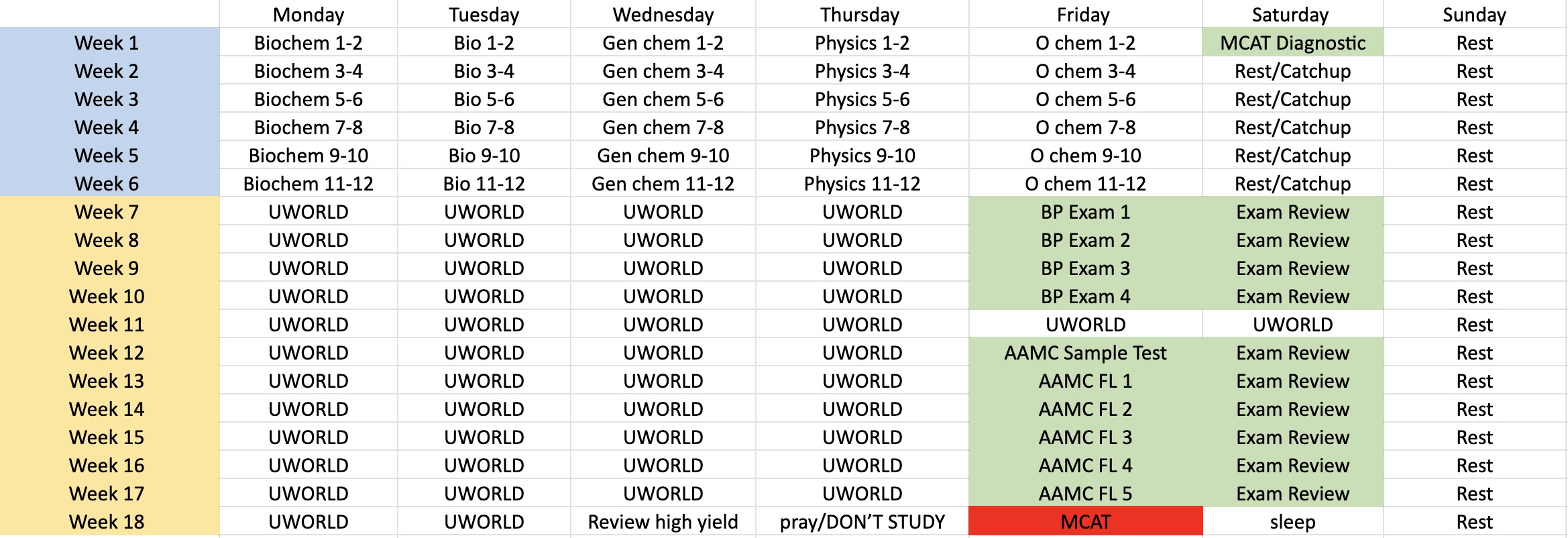
At the end of the dedicated content review is when the focus will change to primarily doing practice problems and reviewing any weak spots in your knowledge. This will likely take 4-6 weeks if studying full time, and 6-10 weeks if studying part time. UWorld is the preferred tool for practice problems but carries a hefty cost, and Jack Westin seems to be the preferred recourse for CARS specifically. I would recommend a consistent routine of practice question banks every day to get into the practice of answering questions, which is the real purpose of this (and any) exam. This would look like a combination of a few CARS passages from Jack Westin, and then question banks from UWorld, following by review of the mistakes, making any new Anki cards if needed, and then doing daily Anki cards. In general, I have two major recommendations for this period in studying. The first is to do weekly full-length exams (FLs) in a setting like that of the real exam – this is something that you can also do in the content review phase of your studying, and I think doing this with 3rd party exams during this time is particularly useful. For your practice exams, go to a quiet place, eliminate any distractions, and take breaks in the same order and timing as the real exam. The goal of this is to practice the process of exam taking, so that the real exam will be a continuation of the practice that you have been doing, as opposed to something new and foreign. However, unless you’re taking AAMC FLs, this will essentially be a question bank that is completed in one sitting, which although maybe not perfectly representative of the real exam, still has merit for building endurance and routine. There are a lot of opinions regarding which 3rd party full-length exams are worth taking and most representative of the real exam, and though this has certainly changed in the many years since I have taken the exam, people seem to prefer Altius, NextStep, and Kaplan, although the CARS sections for both companies (and most 3rd party FLs) are not representative of AAMC. AAMC FLs should be saved for the end of your studying and completed in the last weeks before the exam. The second (and more important) recommendation is to rigorously review mistakes made in the full-length practice exams – after taking a break post-practice exam, the rest of your study time for that day should be spent reviewing the exam as the content and your rationale is still fresh in your mind. Of course, if you find your focus waning during this time, just split up the review, as it really shouldn’t be something done by “going through the motions”. This was challenging for me to do during the MCAT, and it wasn’t until Step 1 that I felt like I was able to be honest and not dismissive of my mistakes. A good way to do this is to make a spreadsheet of the mistakes, and then make Anki cards of the subject/content if the mistake was in conceptual/content knowledge. In the spreadsheet, you should include the content category, subtopic, rationale and mistake in your reasoning, and then the correct reasoning. Categorizing and cataloging the mistakes will help you to identify trends or areas of weakness in your study which you can the remedy through focused content study, and I reviewed I reviewed my version of this document all the way through the week before my actual exam.
My last recommendation is to ignore FOMO. Make a plan and stick with it. You can be flexible in adding or removing things that are not working in the studying but try and set hard limits/be firm with how much advice and change you’re willing to read/make during your study process. For both the MCAT and Step 1, I remember seeing posts on SDN/Reddit of people who got exceptional scores on the exam with their breakdown of what to do (I do see the irony in this given the purpose of this post and website…), and I would try and adapt and change what I was doing out of the fear of missing a crucial technique or way to potentially improve my score. Don’t get lost in the sauce. Before you start studying, find/purchase all the resources you intend to use. Set aside time to make a personalized plan of how to approach studying, integrating the advice from myself or others on Reddit or SDN, and then follow your plan. Make sure to include breaks and flex time within your schedule, as things will inevitably come up and disrupt your plans, and devoting focused time to studying is much better than burning out because you didn’t want to take a day off (except for Anki, keep reviewing that on your “off-days”).
April 20, 2025
I pulled most of these from Reddit posts and comments, you can find the links to the original posts/comments at the end of the document
February 9, 2025
One of the most essential parts of science is communication. Begin able to eloquently communicate your research, your motivations for pursuing research, and to do so with confidently and comfortably with different audiences is a skill itself and deserves practice. Personally, I think there are three different “versions” of a prepared research talk that are useful to practice: the elevator pitch, a longer research description, and a research motivations and goals talk. Before we talk about those, we need to first talk about the crucial part of any conversation about science – knowing your audience.
Knowing your audience is a crucial part of any form of communication, and science communication is no different. The specific foci and things you choose to highlight will differ if you’re talking to a policymaker versus a family member versus a tenured PI. For most “elevator pitches”, your audience will be either faculty/colleagues, or lay public. For other versions of the prepared research talk, most of your audience members will be those involved in science, either in your field or adjacent areas. Regardless, there are a few universal considerations that you should consider regardless of the audience.
When you’re introducing numbers or statistics (which is very useful for supporting your findings or motivations of your work), there are a few tricks you can use with your phrasing to improve your communication and impact. First, avoid using probabilities and stick to natural frequencies (i.e. instead of saying “the probability of getting X disease is 1%”, say “1 in 100 people get X disease). Second, avoid anchoring results in statistical significance, as this can be challenging conceptually depending on your audience. Instead of saying your p-value, talk about the magnitude of the effect size, again using a natural frequency if possible.
While field specific terms and jargon are useful shorthand for communicating quickly with our colleagues, they can be unknown and misunderstood when talking with people outside of our discipline. When you’re constructing your talk, try to replace more scientific terms with ones of the same meaning (e.g. “low oxygen” instead of “hypoxic”, “DNA damaging” instead of “mutagenic”) to improve clarity and understanding.
Even though it’s called an elevator pitch, this will be the most useful talk to prepare, and will come in handy at conferences, meetings, or simply describing the gist of your research to your peers or colleagues. As stated above, you first need to frame your work around the question of What is the “big problem”: Contextualize the issue that you are studying. It is best to start quite broad. If your research is related to disease or illness, start by describing the frequency, overall survival, or other important statistics about the disease itself. If your research is focused on basic science, focus instead on the limitation in knowledge you are trying to solve, or other motivations for pursuing the research. For the introductory sentence, it’s important to frame the core problem of your research with as wide of a lens as possible. “X disease is bad and impacts Y amount of people”. “X is a large issue in biology and furthering our understanding will help us to do Y”.
January 29, 2025
To get a good idea of what can be done with an MD/PhD, our best reference frame is those who have completed their training. The AAMC puts out yearly reports of data gathered from residency applications and makes it available as a comprehensive report (Charting Outcomes) and gathers similar data from medical school applications (FACTS). Less frequently, they do assessments of the workforce and former trainees, and in 2018 the AAMC conducted a study to look at the outcomes of physician-scientists produced by the MSTP & MD/PhD programs from around the country which can be found here. While some of the data will have certainly changed in the past 7 years since this study was conducted, it is still useful to understand the common outcomes and careers of the people who have completed this training. The survey was (unsurprisingly) voluntary and had a completion rate of 44%, and although they note that the response rate was similar between sexes, it is impossible to know if there is bias with respect to the outcomes of those who completed the survey, e.g. academic physicians preferentially responding.
January 12, 2025
MD-PhD programs are long. In recent years, there have been pushes in medical schools and MSTP/MD-PhD programs to reduce the overall length of training. When looking longitudinally, we can see how the timeline to having a career (and lab) of one’s own can be quite extended: 6-10 years for MD/PhD, 3-6 years for residency/fellowship, and a few years of postdoctoral research, and maybe post-baccalaureate research prior to all of this. The biggest factor that will determine the time to completion of dual degrees is your PhD lab. Because medical school curricula are more-or-less fixed in their schedules, the differences in time to completion of MD-PhDs comes from the PhD phase of time. Your PhD lab will determine the topic area and scope of your individual projects, your level of independence or collaboration with others in your lab/externally, and a reference frame for what amount of work in sum can constitute a PhD. The average time to completion of biomedical PhDs in the United States floats around 5-6 years, and MSTPs are able to help reduce this usually by double-counting MD coursework towards the coursework requirements of PhD programs. However, the time constraints and logistics of re-entering the medical school curriculum can pose unique challenges to MD/PhD students in their PhD phase, leading many to pursue projects with defined goals and endpoints, and incentivize projects that use existing resources in the lab. That isn’t to say that it is impossible to go off on your own, as many students are able to leverage this opportunity to do so and find success through it. Because of these constraints, it’s important to have frank conversations with your PI or potential PIs about your timeline. If finishing your PhD work within a 4 year timeframe is essential, you need to communicate that to the PIs you meet with/rotate with. Moreover, this is another instance where talking to students currently in a lab can be very useful, as it can provide you a better glimpse of implicit expectations of a PI with respect to time to completion: If the majority of PhD students in a lab are finishing in ~6 years, it may be challenging to get something off the ground and sufficient to finish your PhD in the restricted timeframe. All that being said, the PhD is a time to sponge up diverse skillsets which you can use in your academic career ahead. You are unlikely to have as much protected time as the PhD affords you to explore topic areas and fail with lower stakes. While time is undoubtedly important and the cause of much stress, taking the time that you need to hone your craft and grow as a scientist is essential, and shouldn’t be rushed.